
Parts of south, east and northeast India are expected to get some relief from the blistering heat, with the onset of monsoon expected to take place over Kerala on Saturday.

A voter turnout of 10.82 per cent was recorded till 9 am on Saturday in 58 constituencies in six states and two Union territories where polling is underway in the sixth phase of the Lok Sabha elections.

The southwest monsoon over the country is likely to be normal in July, the India Meteorological Department (IMD) said on Thursday in its forecast for the month.

The national capital, parts of which reeled under heatwave conditions for the past few days, had some relief on Wednesday with strong winds and partly cloudy skies witnessed during the day.

"We are expecting that the temperature will be higher than normal in the entire northwest India and the adjoining central India, starting with Gujarat, Rajasthan and up to east Madhya Pradesh and Chhattisgarh," he said at a virtual event on 'Building Climate Resilience for the Most Heat Vulnerable'.

A tormenting heatwave swept through North India on Sunday with the mercury crossing 49 degrees Celsius in pockets of Delhi, while the weather office forecast some relief Monday onwards.

The EC said polling percentage in the Anantnag-Rajouri seat in Jammu and Kashmir is the highest in 40 years.

An approximate voter turnout of 59.06 per cent was recorded in the sixth phase of the Lok Sabha elections on Saturday in 58 constituencies across six states and two Union territories with the polling percentage in the Jangal Mahal region of West Bengal touching 78.19.

India is set to experience extreme heat during the April to June period, with the central and western peninsular parts expected to face the worst impact, the IMD said on Monday as the country prepares for seven-phase general elections from April 19.

Please promise, especially those millions who trust you with their hard-earned money, never to let your voting preferences determine your actions on the markets. The most appalling and scary phenomenon was fund houses and brokerages going out on election yatras and writing copious reports promising more than 300 for the BJP. That was your wish as voters. Your investors are paying for it now, points out Shekhar Gupta.

The heat wave is the result of an anti-cyclone over Pakistan and western Rajasthan, the impact of which is being felt across the northern plains.

Intense heat swept through east India and parts of the southern peninsular region on Thursday, testing power grids and prompting the Kerala government to order closure of educational institutions till May 6.

In the event of the BJP's poor performance in the assembly polls this year and in early 2025, Modi's hold will get further weakened because he will no longer remain the invincible electoral persona tightly controlling the machine at his disposal, asserts Nilanjan Mukhopadhyay.

Delhi's primary weather station, the Safdarjung Observatory, registered a maximum temperature of 40.4 degrees Celsius, four notches higher than normal.

The national capital battled weather conditions in the "red category" as the maximum temperature recorded at the Palam observatory was 46.1C,

In Phase 6, indications are that the BJP, which is defending 40 seats, will lose in double digits and gain in single digits. Not good, if you are the ruling party scrambling to earn a working majority, with just one phase left to go, argues Prem Panicker.

With the cooling down of heatwaves as the monsoon spreads across the country, power demand has fallen by 12.5 per cent from the start of this month till Monday. Peak power demand of the country had touched a record of 210 Gw last week, mostly due to rising temperatures and opening up of the economy. Compared with the beginning of this month, almost all states have seen a fall in power demand. Punjab, however, is an exception where the power demand on Monday was 17 per cent higher than on June 1.

In Rajasthan, 13 deaths related to rain and storm were reported over the last two days while at least 12 people were killed due to lightning strikes in Jharkhand during the same period, officials said.

Large swathes of the country reeled under heatwave conditions on Tuesday with Churu in Rajasthan recording a high of 48 degree Celsius.

The average temperatures observed pan-India for April was 35.05 degrees, which was the fourth highest in 122 years.

India is likely to experience below-normal monsoon rainfall this year, with a 20 per cent chance of drought due to the end of La Nina conditions and the potential for El Nino to take hold, private forecasting agency Skymet Weather said on Monday.

Temperatures in March will be critical to determining the impact of any unusual heatwave conditions on this year's wheat crop in North India. It is that time of the year when the crop enters its vital grain-filling stage, say meteorologists and crop experts. So far, the high day temperatures in the North are not believed to have any significant impact on the final yields since the crop hasn't entered a stage where heat affects yields.

Gurugram in Haryana witnessed a scalding 48.1 degrees Celsius, the highest since May 10, 1966, when the city logged 49 degrees Celsius.

After a ban on wheat exports, India's cereal grain procurement for the central pool was struggling to rise significantly until the middle of last week, informed trade and market sources. Farmers have been holding on to their produce as the price of wheat in the open market recouped some of the losses it suffered in the aftermath of the ban. According to trade estimates, around 18.12 million tonnes (mt) of wheat was procured in the central pool up until May 18. Before the export ban was enforced on May 13, it was 17.96 mt.

In Delhi, Safdarjung, the base station for the national capital, recorded 44.2 degrees Celsius, while Mungeshpur observatory in northwest Delhi, reported 47.3 degrees Celsius.

India's wheat production is projected to have declined nearly 3 per cent to 106.84 million tonnes while the overall foodgrain production is estimated to have touched record 315.72 million tonnes in the 2021-22 crop year. The wheat production is estimated to have declined due to heatwave that resulted in shrivelled grains in the northern states of Punjab and Haryana. Releasing the fourth advance estimate for the 2021-22 crop year, the Union agriculture ministry on Wednesday said a record output is also estimated for rice, maize, gram, pulses, rapeseed and mustard, oilseeds and sugarcane.
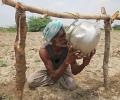
Santosh Patkar of Devgadh Taluka Sindhudurg district of Maharashtra is a worried man these days. Devgadh, which is known as the home to world famous Alphonso variety of mangoes, has seen an unusual drop in yields which is affecting farmers' income. Being one of the primary agricultural produce from the area, Santosh is not untouched by this somewhat rare phenomenon. He said in his own mango garden, yields have come down by a third from most trees.
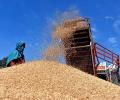
The government has no plans to import wheat as it has sufficient stocks to meet the country's requirements, official sources said. The Food Corporation of India (FCI) has enough stock for public distribution, they added. "There are no plans to import wheat into India. "The country has sufficient stocks to meet our domestic requirements," a source said.

The mercury in Delhi, which recorded its hottest day of the year so far at 45.6 degrees Celsius on Sunday, came down to 42.4 degrees Celsius, according to the India meteorological department.

In the first of a two-part series, Business Standard examines the impact of the upcoming summer on agriculture and drinking water supply.

Delhi is likely to receive the first monsoon showers on June 30 or July 1, India Meteorological Department (IMD) officials said on Tuesday.

Parts of Telangana are currently reeling under a heat wave that has already claimed 21 lives even as the meteorological department officials warned that day temperature would shoot up further.

"The season averaged maximum temperatures in Himachal Pradesh, West Rajasthan, Konkan, Goa, Coastal Karnataka, Kerala and Arunachal Pradesh are likely to be higher than normal by 0.5-1.0 degree Celsius," the Met department has said in its forecast.

The four, including two women, were seated in S-8 and S-9 coaches, which are non-AC, and other passengers claimed that they died due to excessive heat.

There was no relief for the national capital, with the mercury crossing the 44C mark in some parts of the city.

IMD has said the temperature in April-June across most parts in India is expected to be 0.5-1 degrees Celsius warmer than normal. However, doctors and scientists say they haven't found any direct correlation between the speed of COVID-19 spread and warm weather.

Of that figure, a whopping 4,246 people died in Andhra Pradesh and Telangana alone.

The dust storm was an outcome of the extremely hot conditions.
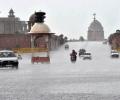
The IMD chief also allayed fears of occurrence of an El-Nino.
